

Qwen3.8 vs Claude Opus 5.5: Why Claude Is My Daily Driver Again
In August, Qwen3.8 replaced Claude as my daily driver. Then the credits ran out in four days. Agentic coding is 98% cache reads, and on cache reads Opus 5.5 is the cheaper model. A follow-up.
In August I wrote that Qwen3.8 had become my daily driver. It did, for a few weeks. This is the follow-up: what sent me back to Claude, and why the deciding price was not the one on the pricing page.
The plan that lasts four days
Both plans I compared cost $200 a month. Claude Max rations that with a weekly limit, so hammering it costs you one week, not the month. Qwen's Max seat gives you 250,000 credits for the whole month to spend however you like. That sounds better until you spend them. Running Qwen through Claude Code at my normal pace, the month's allowance lasted about four days. Keeping that pace for a full month would take seven or eight seats.
Agentic coding is a cache-reading workload
Input and output prices describe chat. An agent works differently: every turn re-reads the conversation, the files it has opened and every tool result so far, and almost all of that comes from the prompt cache.
I counted the last 30 days of Claude Code logs across my two Macs:
| Token type | Tokens | Share |
|---|---|---|
| Cache reads | 39,459,927,749 | 98.2% |
| Cache writes | 633,785,528 | 1.6% |
| Output | 73,779,913 | 0.18% |
| Uncached input | 410,887 | <0.01% |
That is over 500 cached tokens read for every token written, nearly 40 billion in a month. At that ratio the output price, the number everyone compares, barely moves the bill. The cache-read price is what you are paying.
On cache reads, Opus 5.5 is the cheaper model
| Per million tokens | Cache read | Output |
|---|---|---|
| Qwen3.8-Max | $0.25 | $6 |
| Claude Opus 5.5 | $0.20 | $20 |
| Claude Fable 5.1 | $0.25 | $50 |
Qwen's output costs less than a third of Opus's, but its cache reads cost 25% more. Price my month at list rates and Opus 5.5 comes to about $12,500 against Qwen3.8-Max's $11,600. A 3.3x gap in output price shrinks to 8% on the bill. Then the subscriptions: $200 of Claude covered the month, and $200 of Qwen covered four days.
Claude fixed the manners
My last post complained about two habits: performed honesty ("one honest caveat", "to be completely transparent") and phantom time estimates. Those habits had been creeping in since Opus 4.8. I said that if Fable got its manners back I would say so here, so here it is.
Fable 5.1 dropped most of the disclaimers. Then Opus 5.5 arrived and was better again. I cannot fault its work, and at $20 per million output tokens against Fable's $50, it is the model I run all day. Anthropic clearly paid attention and trained the habits out.
These days I do not use Fable at all. Opus 5.5 does the work, and Claude Mythos 5.1 audits it: the other Claudes' code, and the apps they ship.
A caveat I cannot resolve
My standing instructions to every agent open with: "If you can say it in 1 line instead of 10, do it." Without it, the important detail gets lost in a sea of text. So when I say Opus 5.5 is concise and gets on with the work, I cannot fully separate the model from the instruction. What I can say is that it follows the instruction.
Where I land
Qwen3.8 is still a good model, and open weights still matter. But for agentic coding, the headline price is the wrong number. Look up the cache-read rate first. On that number, and on the quality of the work, Claude is my daily driver again.
Addendum: the month I spent in a day
A footnote to my own argument. I'd paid for this month's Qwen seat and forgotten all about it. With the clock running out, I handed the problem to Claude: keep a team of Qwen agents busy on real work until the credits are gone.
It took 27 hours. rust-agent logged 6,619 model calls: 17.1 million fresh input tokens, 1.07 billion read from cache, and 8.7 million output tokens. That was 232,000 of my 250,000 credits. The only break came at 00:18, when my laptop's battery died. I hadn't plugged it in. At 07:56 I got Claude back online, and three minutes later the Qwen team was running again.
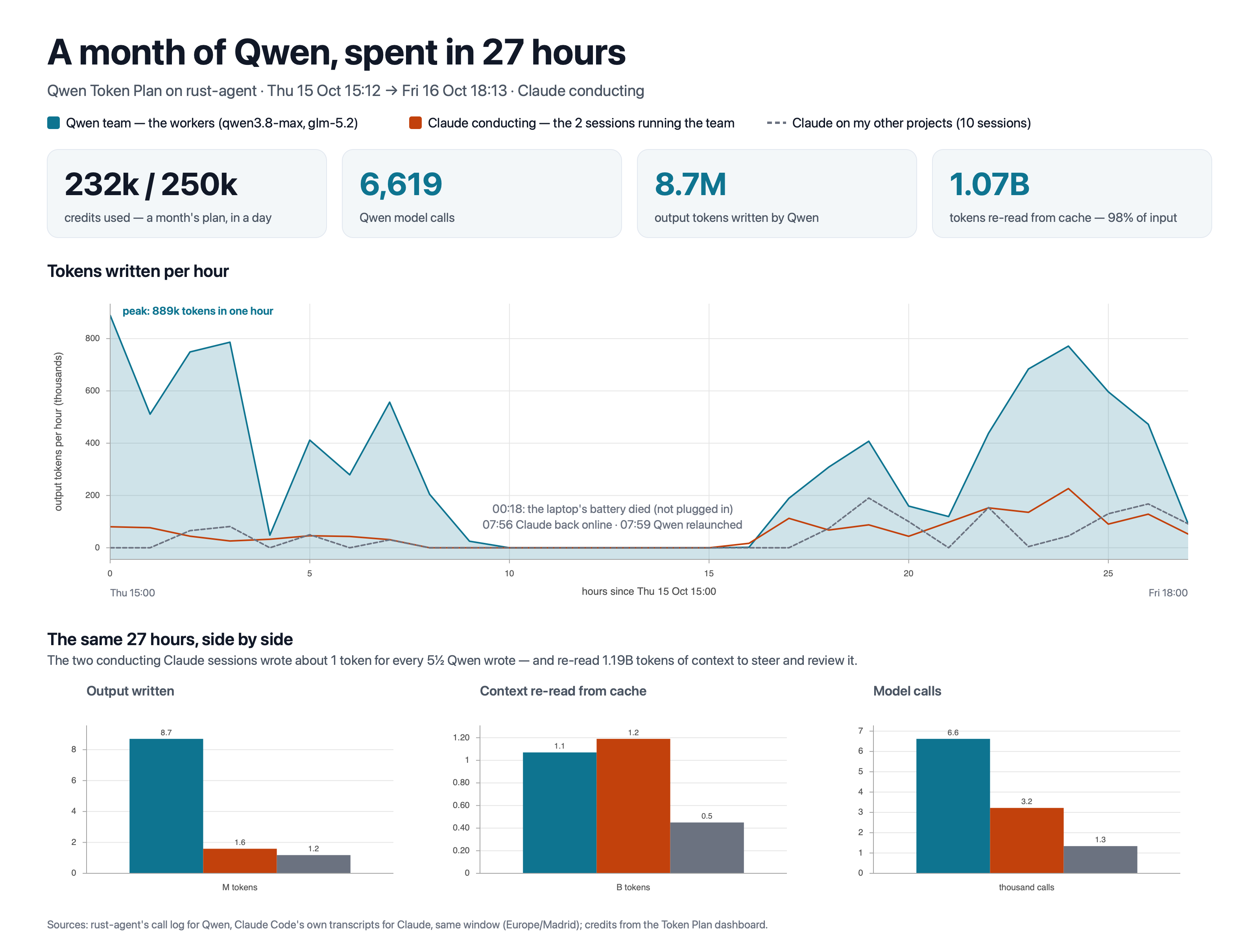
I didn't do much. Two Claude sessions wrote the briefs, gave each Qwen agent its own git worktree, and sent every finished branch to a different Claude model for review. They passed the findings back, re-reviewed the fixes, and merged and packaged the result.
The reviews are the part worth telling. Most branches came back "merge after fixes", and the fixes weren't cosmetic:
- In the code editor, a slow formatter could write one file's contents into another, and one that printed nothing would wipe the file.
- The new terminal manager could close the wrong agent if panes were renumbered while the confirmation was open.
- A colour setting made the agent ignore its whole settings file, permission rules included.
- A pane viewer matched panes by substring, so one agent could rename itself and receive my keystrokes.
The economics make the same point as the rest of this post. At list prices the Qwen side came to about $352, from a $200 seat, and three-quarters of it was cache reads rather than writing. The two Claude sessions conducting it came to about $314 at Opus 5.5 and Fable 5.1 list prices, for under a fifth of the output. Qwen wrote fast and cheap. Claude caught what would have hurt.
Per-token prices are list rates as published on OpenRouter on 16 October 2026 (Qwen3.8-Max 0902; the Claude rates match Anthropic's API pricing). Qwen plan details are from Alibaba Cloud's AI Coding Plan page. Token counts come from my own Claude Code session logs on two machines for the 30 days to 16 October 2026, one count per API request; cache writes are priced at Anthropic's 5-minute rate and Qwen's implicit-cache creation rate. Release dates as reported: Claude Fable 5.1 and Claude Mythos 5.1, 1 September 2026; Claude Opus 5.5, 22 September 2026.